A Natural Solution to the Replication Crisis in Science
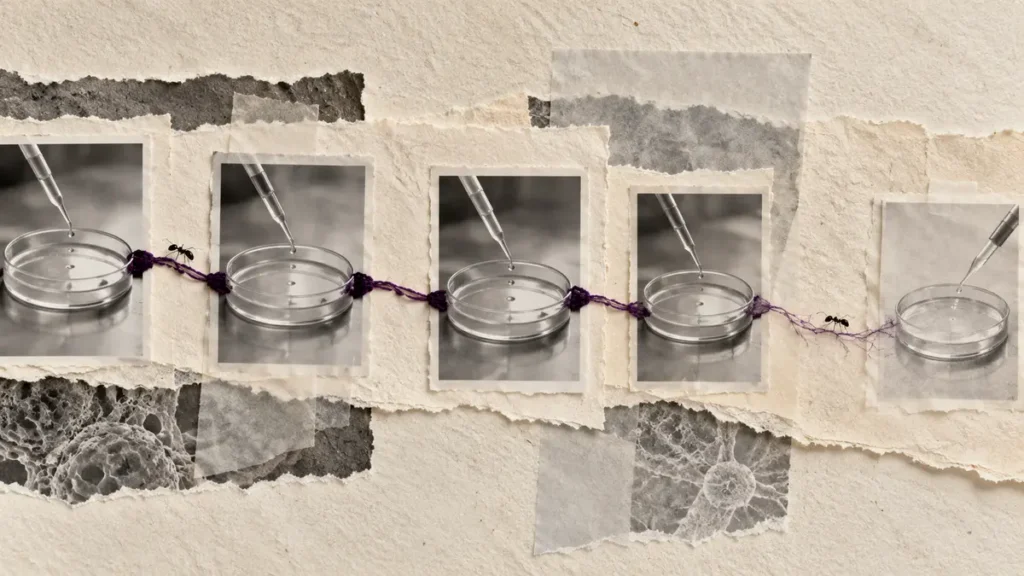
Orit Peleg and Jonathon Keats propose that science borrow from pharaoh ants, whose pheromone trails strengthen when food is repeatedly found and fade when evidence goes stale. They connect this natural system to replication failures, suggesting publications track how recently and often results were retested, with confidence decaying faster in volatile fields. Examples from pigeons and chimpanzees support a broader call for biomimicry and multispecies research heuristics.
Opens on nautil.us · Curated by GlobeRead
GlobeRead's Take
The replication crisis is often framed as a problem of incentives, statistics, or misconduct, yet it is also a problem of institutional memory. Journals preserve claims far more easily than they preserve uncertainty about when those claims were last tested. That mismatch grows more consequential as search engines and AI systems recirculate old findings with little sense of freshness. The broader question is not simply how knowledge is published, but how a community should let confidence change over time.nnPharaoh ants offer an unexpectedly disciplined model. Their foragers lay pheromone trails to food, reinforcing routes that continue to pay off while volatile chemicals allow abandoned routes to fade. The colony stores memory in its environment, a form of collective problem-solving called stigmergy. Applied to research, the analogy suggests recording the date, frequency, and interval of replications as publication metadata. A nutritional claim in a fast-changing field might lose confidence sooner than an astronomical result grounded in comparatively stable conditions.nnThe proposal becomes more provocative when it moves beyond ants. Pigeons learn to switch in the Monty Hall problem, while humans often cling to the first choice; chimpanzees can discard pointless steps in a transparent puzzle where people keep copying them. No species is presented as universally rational. Instead, different evolutionary histories produce different shortcuts and blind spots. Borrowing several nonhuman heuristics could help researchers cross-check habits that feel natural only because they are human, including the hunger for novelty and breakthrough claims.nnWe picked this essay because its biomimicry is specific enough to argue with. Researchers, editors, science communicators, and readers interested in how institutions update beliefs will find a fresh design question rather than another diagnosis of failure. The proposed decay of untested knowledge raises practical and ethical objections, but that is part of its value: it forces confidence to become visible and revisable. What would a scientific record look like if forgetting, carefully engineered, were treated as a feature rather than a flaw?
We curate the internet's most interesting articles — science, psychology, history, philosophy and more. Always free, no algorithm.