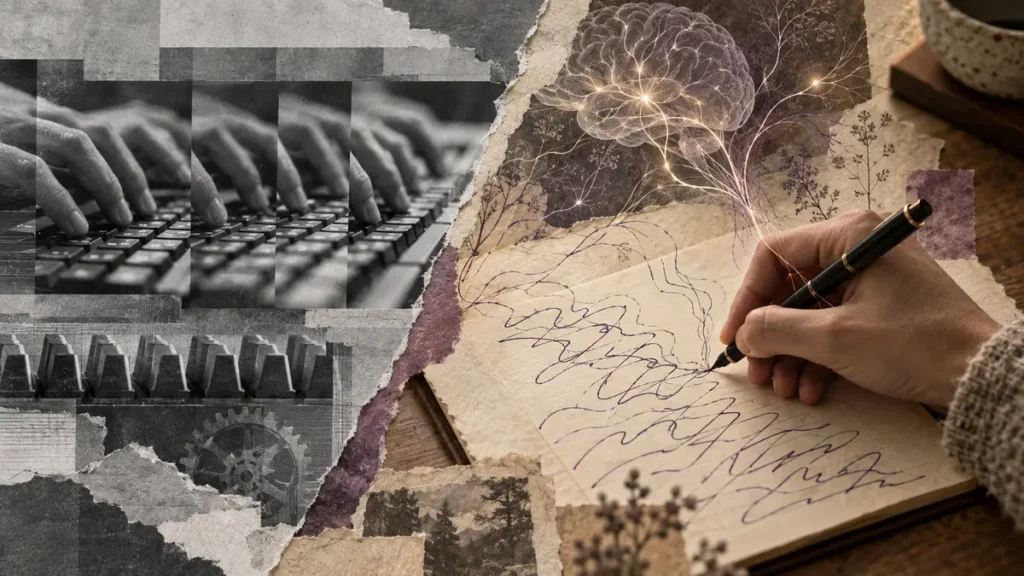
Make This Note-Taking Switch If You Want to Learn Faster
Neuroscientist Dr. Patricia Schmidt walks through the body of research showing that handwritten notes outperform typed notes for retention and comprehension. She features the now-classic Mueller & Oppenheimer (UCLA / Princeton) study where participants who took longhand notes during TED Talks scored substantially better on conceptual questions than those who typed, even when the typists captured more raw words. Recent fMRI work shows handwriting engages more distinct brain regions than typing.
Opens on medium.com · Curated by GlobeRead
GlobeRead's Take
Most of us made the switch from notebooks to laptops without thinking about it, and the productivity argument was obvious at the time — typing is faster, more searchable, more portable. Schmidt's piece is interesting because it refuses to treat that conclusion as settled. The piece arrives at a moment when even more of our note-taking has been outsourced to AI summaries and voice-to-text transcripts, and the question of what we actually retain has become much sharper.nnThe central evidence is the Mueller and Oppenheimer "pen-is-mightier-than-the-keyboard" study, which Schmidt walks through carefully. Participants watched roughly 15-minute TED Talks while taking notes — half on laptops, half by hand. On factual recall the two groups performed similarly. On conceptual questions — the ones that required actually understanding the material — the handwriting group substantially outperformed the typists. Crucially, the typists captured more total words. The advantage of slowness was that it forced them to compress, paraphrase, and decide what mattered in real time, which is what learning actually consists of.nnThe second piece of evidence Schmidt brings in is recent neuroimaging work showing that handwriting activates a richer, more distributed network of brain regions than typing — visual, motor, somatosensory, and language areas firing together in a way that keyboards never produce. The motor act of forming letters appears to be doing real cognitive work, not merely producing a record. The implication is uncomfortable for the laptop-dominant classroom: speed of input may be inversely correlated with depth of encoding.nnWe picked this because the question — what we actually keep from what we hear — sits underneath nearly every adult learning situation. Useful for students, knowledge workers, parents, and anyone whose desk is currently covered in a laptop instead of a notebook. The unsettling question is how many of your own laptop-typed notes you could reconstruct without the file.
We curate the internet's most interesting articles — science, psychology, history, philosophy and more. Always free, no algorithm.