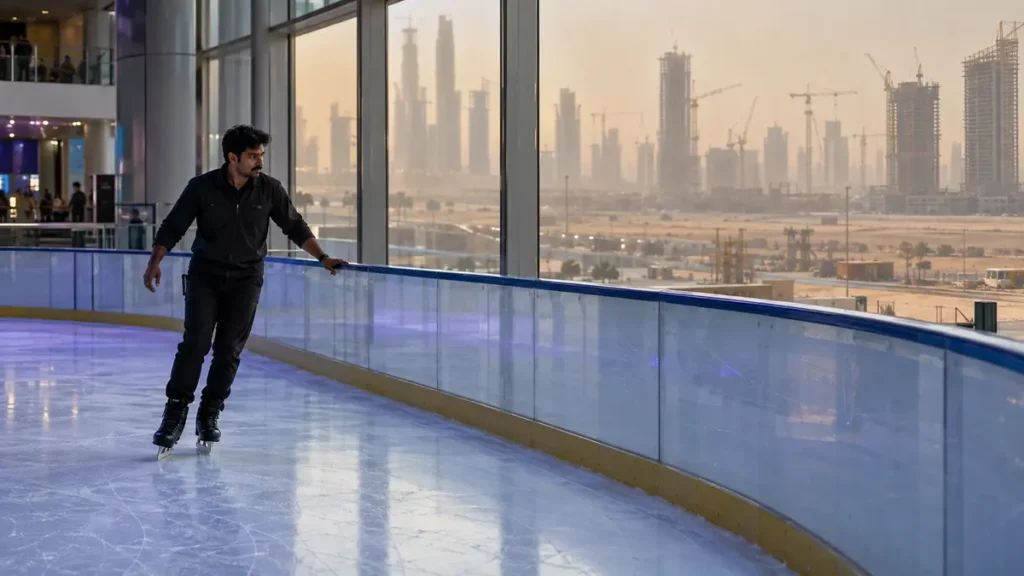
The Ice-Skater
Kanak Kapur’s novella follows Indian migrant workers Yogan and Samar as they pursue opportunity in Dubai. Both confront crowded housing, restricted movement, debt, and exploitative labor, but their paths diverge when Yogan becomes an ice-skating instructor and brings his family over while Samar is trapped by a hidden loan and growing despair. Their friendship reveals the fragile line between mobility, survival, and collapse.
Opens on www.newyorker.com · Curated by GlobeRead
GlobeRead's Take
Dubai’s gleaming architecture is often narrated through ambition, luxury, and spectacular engineering, while the labor that sustains it remains offstage. Kapur places two migrant workers at the center and uses an indoor ice rink—an impossible winter built in the desert—as both workplace and metaphor. The story matters because opportunity and exploitation coexist here, making success look less like proof of fairness than a narrow path some can reach.nnYogan’s movement from construction labor to skating instructor turns physical balance into social mobility. Learning to glide requires trust, repetition, and freedom from the barrier, but his progress also depends on luck, temperament, and access to a rare opening. His eventual ability to bring his wife and daughters does not erase the system’s harshness; it shows how individual advancement can occur inside conditions that remain dangerous for everyone else.nnSamar’s hidden contractual loan reveals the opposite trajectory. Debt converts employment into confinement, while distance and deteriorating contact with his wife weaken the relationships that might anchor him. Yogan’s care cannot overcome legal, financial, and psychological pressure accumulating around his friend. Their different fates resist an easy moral about resilience: two men can work, hope, and support each other, yet encounter radically unequal margins for error.nnWe picked this novella because it gives structural exploitation a human rhythm without turning its characters into examples. Readers interested in migration, labor, friendship, Gulf economies, or contemporary fiction will find both lyrical detail and moral clarity. The rink’s smooth surface, surrounded by a city built through punishing work, holds the story’s central contradiction beautifully.The friendship remains moving because care matters even when it cannot defeat the legal and economic machinery pressing upon a vulnerable person. When one man learns to glide and another cannot escape the contract beneath his feet, what exactly separates progress from falling?
We curate the internet's most interesting articles — science, psychology, history, philosophy and more. Always free, no algorithm.