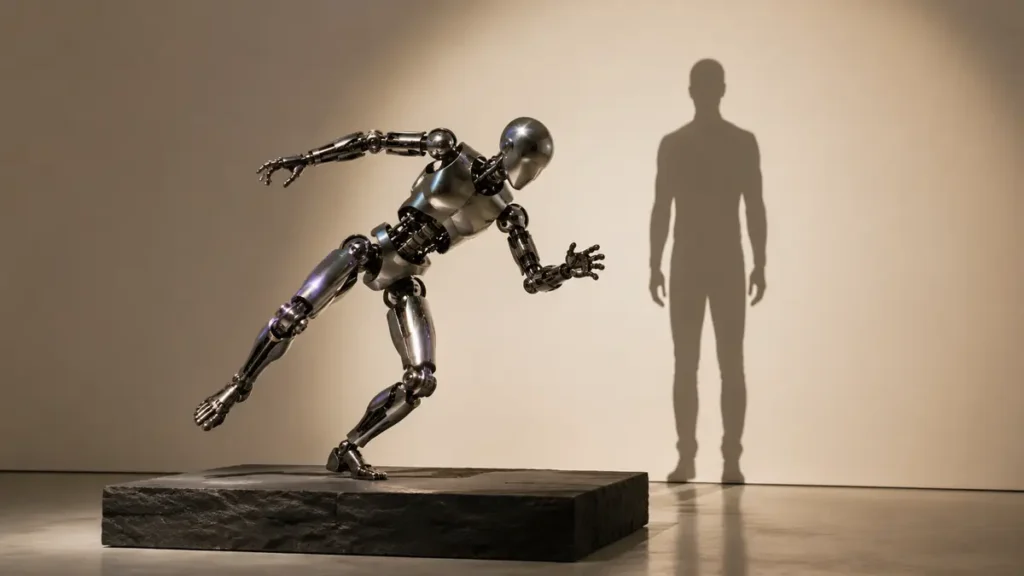
Why We Love Watching Robots Fail
Kyle MacNeill explores the pleasure people take in videos of humanoid robots stumbling, crashing, and catching fire at the World Humanoid Robot Games. He links robot schadenfreude to anxiety about automation and generative AI, arguing that mechanical failure punctures claims that the future is inevitable even as rapid improvements suggest the joke may be short-lived. The essay frames this laughter as species-level bonding against a machine future.
Opens on time.com · Curated by GlobeRead
GlobeRead's Take
A falling robot is funny in the oldest slapstick sense, but it also performs cultural reassurance. At a moment when machines are described as future workers, artists, soldiers, and companions, watching one lose balance lets an anxious audience briefly reverse the hierarchy. The laughter is less about circuitry than about preserving a human claim to competence.nnMacNeill notices how technical failure punctures inevitability. Promotional narratives often present automation as a destination society has already chosen; a robot crashing into a barrier restores contingency. The machine is not destiny but an unfinished artifact, dependent on engineering decisions, capital, infrastructure, and tolerance for error. Ridicule becomes a crude form of democratic skepticism, reminding spectators that impressive demonstrations do not settle where or whether a technology belongs.nnYet the comfort can mislead. Humanoid performance is improving quickly, and a spectacular failure is not evidence of permanent incapacity. Viral clips also select for drama: thousands of successful movements disappear behind one combustible finish. Our attention therefore creates a distorted scoreboard, just as amusing mistakes by generative systems can obscure steady gains. Laughing may relieve fear while preventing the more demanding work of deciding which uses deserve support, regulation, or refusal. There is also a status dimension: the closer a machine resembles us, the more its awkwardness protects the idea that human movement, judgment, and resilience remain special. Humanoid design invites comparison and therefore intensifies both wonder and mockery.nnWe picked this because it reads a meme as a window into technological psychology. It will interest readers following AI, robotics, labor, or the ways online crowds turn uncertainty into comedy. The essay neither asks us to stop laughing nor confuses speed records with wisdom; it shows why humor can bond people while concealing how fast the object of the joke is changing. What happens to that shared joke when the robot stays upright?
We curate the internet's most interesting articles — science, psychology, history, philosophy and more. Always free, no algorithm.