Africa’s Green Revolution threatens traditional foods
Million Belay and Timothy Wise argue that AGRA’s subsidy-led promotion of commercial seeds, fertilisers, and maize monocultures has displaced more diverse African food systems without delivering the promised productivity gains. They cite modest maize-yield growth alongside declining millet, cassava, and groundnut performance, and call for investment in farmer-managed seeds, crop diversity, and Indigenous knowledge.
Opens on www.aljazeera.com · Curated by GlobeRead
GlobeRead's Take
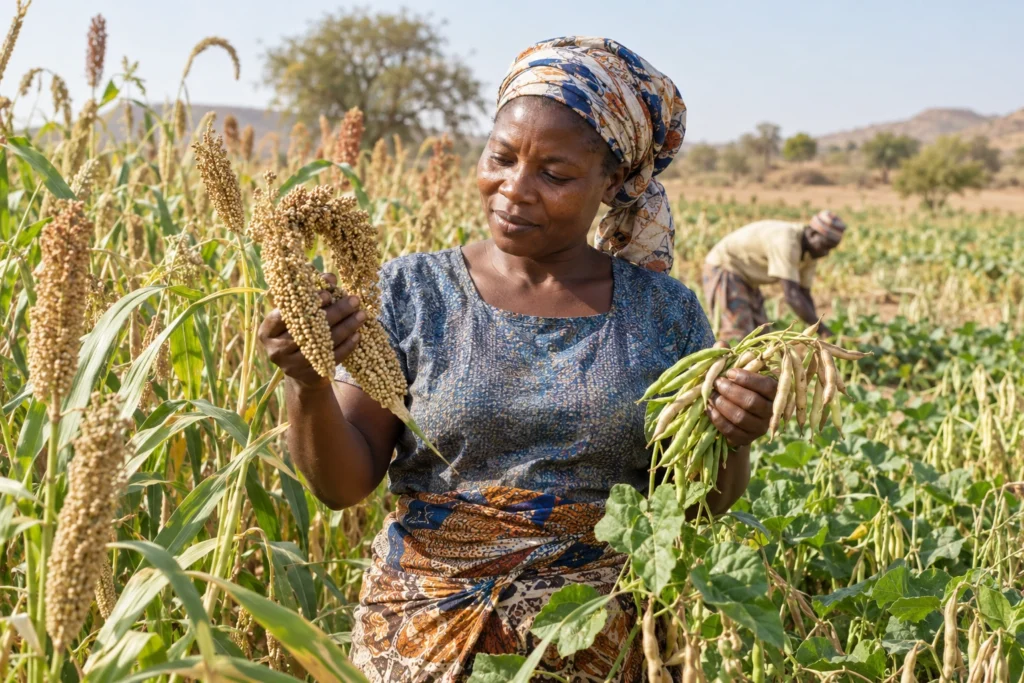
Food policy often treats higher production of a favored crop as evidence of progress. Climate instability makes that equation increasingly dangerous, because a field optimized for one harvest can become a system with fewer ways to survive drought, pests, input shocks, or disrupted trade. The argument here asks readers to judge agricultural success by resilience, nutrition, and farmer control as well as tonnage.nnMillet provides the essay’s clearest test. Across countries participating in AGRA programs, maize production more than doubled as the area planted expanded, yet maize yields rose only 40 percent over 18 years, far below the promised 100 percent. Meanwhile, millet production fell 27 percent, its yields declined 17 percent, and its cultivated land shrank. Those numbers suggest that subsidies can successfully redirect land without necessarily creating the productivity revolution used to justify them.nnThe loss is cultural and ecological as well as statistical. Millet, sorghum, fonio, cowpeas, cassava, and Indigenous vegetables carry locally adapted seeds, preparation knowledge, and food traditions. A diverse farm also spreads risk and supports soil health through rotation. It preserves options that become especially valuable when weather patterns stop behaving predictably. Belay and Wise therefore challenge a development model centered on certified seed turnover and commercial input markets. Their alternative is not opposition to improvement, but investment that protects farmers’ ability to save, exchange, and develop seeds while deciding which crops belong in their fields.nnGlobeRead selected this argument because it reveals how a policy can meet a narrow metric while weakening the system around it. Readers concerned with climate adaptation, food security, development finance, or African political economy will find evidence worth examining, even if they want to test the writers’ interpretation against AGRA’s response. Its central tension will remain relevant beyond the anniversary that prompted it. When resilience depends on having many options, why do institutions keep rewarding uniformity?
We curate the internet's most interesting articles — science, psychology, history, philosophy and more. Always free, no algorithm.