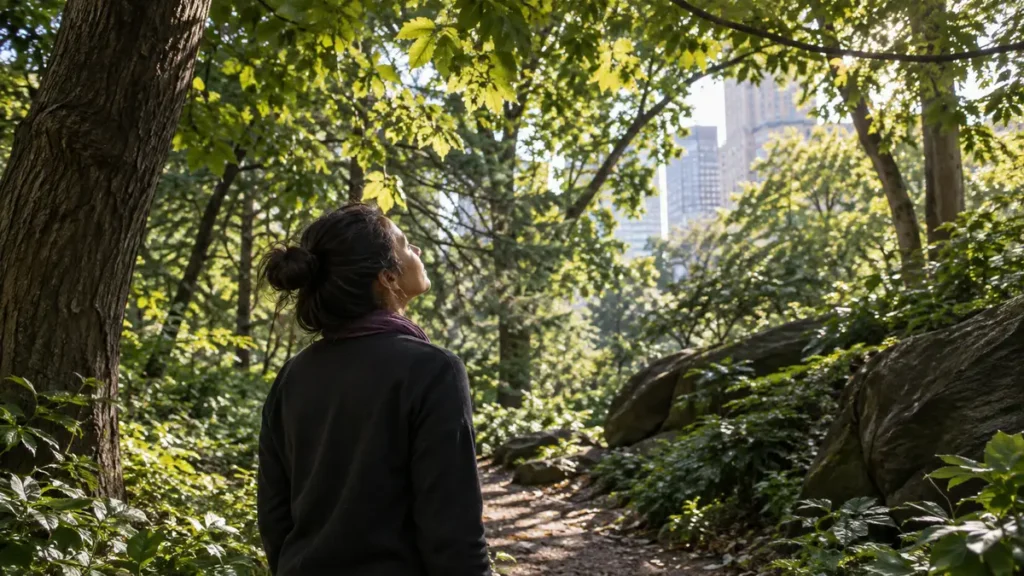
How to Get the Biggest Mental-Health Boost from 15 Minutes Outdoors
Angela Haupt explains research on gaining mental-health benefits from brief contact with nature. A meta-analysis of 78 experiments involving about 6,000 people found that 15 minutes in urban green space could reduce anxiety, stress, anger, depression, and fatigue, with urban forests especially effective. The article distinguishes presence from mere exposure and suggests sensory attention, emotion, beauty, meaning, compassion, and a daily Three Good Things exercise.
Opens on time.com · Curated by GlobeRead
GlobeRead's Take
Nature is increasingly packaged as another wellness dose to optimize, yet a timer alone cannot create the experience researchers are describing. The deeper issue is attention: urban life places greenery within reach of many people while screens and habitual hurry make it easy to pass without noticing. That tension turns a simple outdoor break into a question about what it means to be present somewhere.nnThe evidence gives the recommendation useful scale. A meta-analysis combined 78 experiments involving roughly 6,000 participants and found measurable benefits after only 15 minutes in urban nature, including reductions in anxiety, stress, anger, depression, and fatigue. Longer visits brought larger gains in some outcomes, but the short exposure still mattered. Young adults appeared to benefit strongly, and dense urban forests stood out, perhaps because they more fully remove noise, pollution, and reminders of daily demands.nnMiles Richardson’s work adds the crucial distinction between proximity and connection. His “Three Good Things in Nature” exercise asks people to record three noticed details each day for a week; reported gains in connectedness and wellbeing persisted for a month. The five pathways—senses, emotion, beauty, meaning, and compassion—also move the practice beyond passive consumption. A phone can support observation through a photograph, but scrolling beneath a tree simply relocates the same attentional loop. Caring for wildlife or volunteering completes the exchange by asking what people give back.nnWe selected this for city dwellers, stressed workers, students, and anyone who assumes nature requires a distant wilderness or an empty weekend. Its practical generosity is that a street tree or view from a window can become enough material for attention. The experiment is not merely to go outside for 15 minutes, but to discover what changes when those minutes are spent looking as though the ordinary world has not already been explained.
We curate the internet's most interesting articles — science, psychology, history, philosophy and more. Always free, no algorithm.