How Chess Trains the Judgment Behind Practical Wisdom
Edwin Ruiz connects Aristotle’s concept of phronesis, or practical wisdom, to habits developed through chess. The essay treats each move as a cycle of evaluation, candidate selection, calculation, comparison, and commitment. Examples involving castling, time pressure, pattern recognition, and mentorship show how players learn to balance general principles with particular circumstances and turn repeated decisions into character.
Opens on www.dayknightchess.org · Curated by GlobeRead
GlobeRead's Take
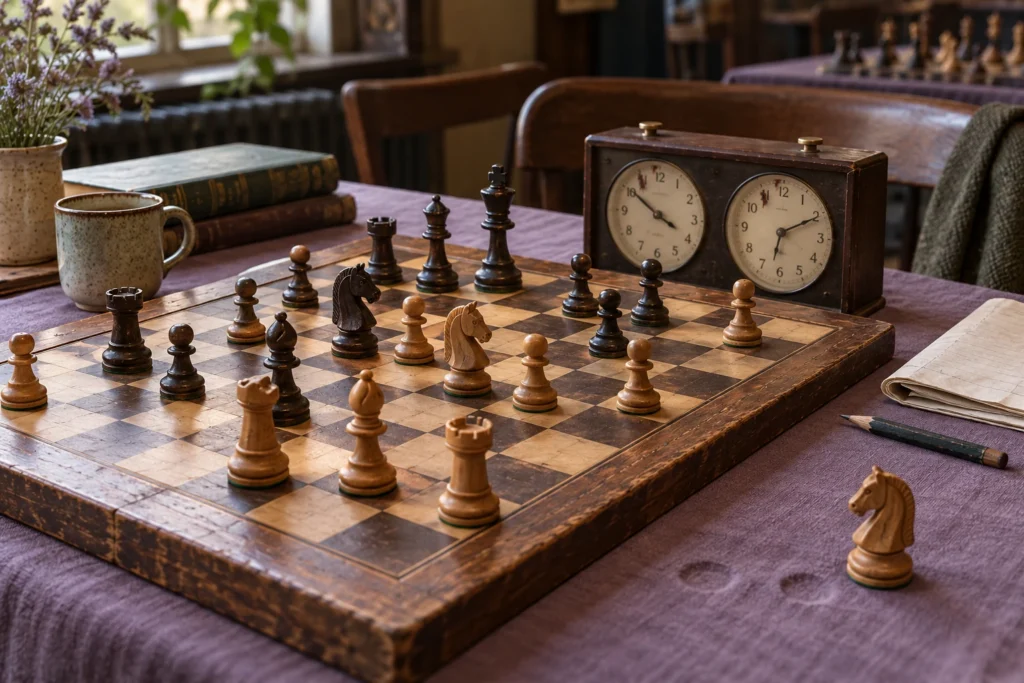
Good judgment is increasingly treated as a talent people either possess or lack, even though most difficult choices are made under pressure, incomplete information, and limited time. Ruiz offers a more hopeful model: judgment can be trained through repeated encounters with consequences. Chess matters here not because every position resembles ordinary life, but because the game makes deliberation visible and gives mistakes immediate, interpretable feedback.nnThe essay’s most useful distinction comes from Aristotle’s phronesis. Practical wisdom is not simply knowing a correct rule; it is selecting the right action for a particular situation. Castling generally protects the king, yet it can invite checkmate when the opponent’s queen and knight already target h2. The rule remains sound, but the position changes its meaning. That small example explains why mature reasoning needs principles without becoming mechanical.nnTime pressure adds another layer. Experienced players recognize structures, tactical motifs, and endgames quickly because thousands of earlier decisions have compressed into pattern knowledge. Their intuition is not a mysterious alternative to reason; it is reason practiced until it can operate faster. Ruiz also emphasizes coaching and community, reminding us that judgment develops through inherited knowledge, analysis with others, and correction—not only through solitary calculation. That claim usefully complicates the romantic image of the lone chess genius. It also makes improvement legible: players can revisit a position, identify the missed cue, and test a better response next time.nnWe selected this essay for chess players, teachers, parents, and readers interested in virtue ethics or decision-making. Its central analogy is strongest when treated as a training model rather than proof that skilled players are automatically wise in every domain. The board offers bounded consequences that life rarely provides, yet its discipline of pausing, comparing, and committing remains portable. What other everyday practice might be quietly shaping the quality of our choices?
We curate the internet's most interesting articles — science, psychology, history, philosophy and more. Always free, no algorithm.