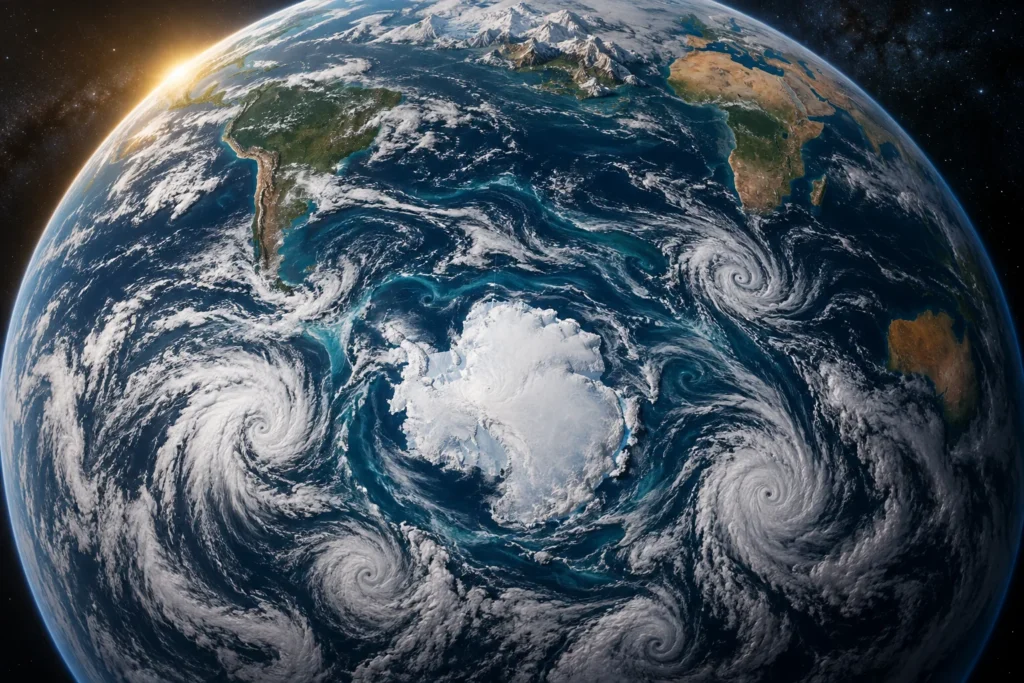
The Southern Hemisphere is stormier than the Northern, and we finally know why
Louise Lerner reports on research explaining why the Southern Hemisphere is about 24% stormier than the Northern. Climate-model experiments attribute roughly half the difference to northern mountain ranges that disrupt airflow and half to ocean circulation that transfers energy between hemispheres. Observations also show the gap has widened since the 1980s, with Southern storminess increasing in a pattern consistent with climate-change models.
Opens on news.uchicago.edu · Curated by GlobeRead
GlobeRead's Take
A simple comparison between hemispheres opens onto a larger challenge in climate science: knowing that a pattern exists is different from knowing what causes it. Satellites made the imbalance measurable, but prediction depends on mechanisms. That distinction matters as communities increasingly ask models for local guidance about hazards, infrastructure, and insurance rather than broad confirmation that the climate is changing.nnThe researchers’ virtual experiments offer an unusually intuitive demonstration of causal testing. When they flattened every mountain in their model, about half of the hemispheric storminess gap vanished. Northern ranges interrupt large-scale airflow, so geography acts as a brake on storm development. The striking image of a mountainless Earth is more than a teaching device; it shows how models can isolate a feature that cannot be removed from the real planet and compare the result with observed conditions.nnOcean circulation accounts for the other half. A slow global conveyor carries water down in the Arctic, through the deep ocean, and upward near Antarctica, redistributing energy in a way that favors stronger southern storms. The historical trend then complicates the picture: Southern Hemisphere storminess has increased since satellite records began, while the average northern change has been small. In the north, ocean-driven effects are offset by extra sunlight absorbed as reflective snow and sea ice disappear, demonstrating that similar forcings can yield different regional outcomes.nnWe selected this for readers curious about how climate models move from correlation toward explanation. The prose makes a sophisticated experiment legible without hiding its assumptions, and it connects nineteenth-century sailors’ experience to satellite records and physics-based simulations. Students, weather enthusiasts, and readers wary of black-box forecasts will find a compact lesson in why models earn trust through mechanisms and independent checks. If two halves of the same planet respond so differently, which familiar weather patterns are still waiting for their hidden controls to be identified?
We curate the internet's most interesting articles — science, psychology, history, philosophy and more. Always free, no algorithm.